
Be the change that you want to see in the world.
-Arleen Lorrance
I saw that quote on a bumper sticker about 34 years ago, and it has stuck with me ever since. I like it because its message implies that we have more power than we think on this planet with 8 billion people. Clearly some people have more influence than others, and I think that can sometimes make us feel like we don’t make a difference. Often you hear that reason for why people don’t vote. To feel empowered, sometimes all you need is a change in perspective.
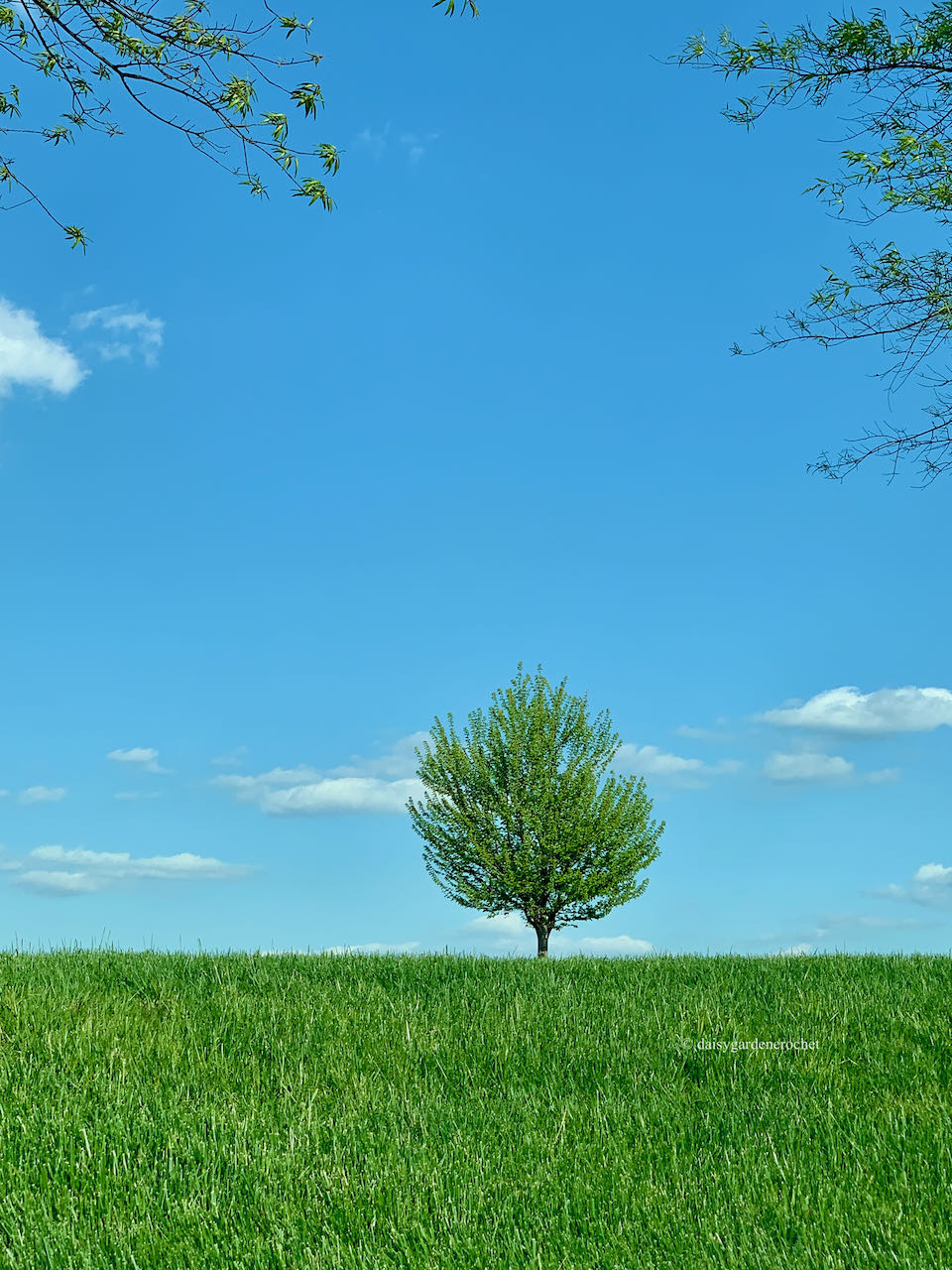
The picture at the top of this post is a good example of how we can see things completely differently with a change in focus. When you look at the bright green pastoral scene, you can almost feel the cool breeze blowing and imagine the happily grazing cow just about to amble into view. Behind the scenes of my photo, the reality was much different. I took that picture in a car dealership parking lot by crouching down and creating the image that I would have preferred to see. The grassy area in the photo’s foreground was the green space surrounding the parking lot. The tree was actually growing in the median of a busy four lane road. By timing my shot and cropping the field of view, I eliminated cars, a fast food place, and an office building from my image. I loved the picture, but the overdevelopment that I saw around the car dealership, and still see on a regular basis, upsets me.
I have been gardening for years and have been slowly working on making my yard more pollinator friendly, but it never occurred to me that I could contribute to the greater good until I learned about Homegrown National Park®. Their mission and goals have completely changed my perspective and filled me with hope. Their approach relies on a collective mentality that only requires that we participate as individuals. You can make a significant difference to insects and birds by planting just one acorn in your yard.
Homegrown National Park® was founded by Doug Tallamy and Michelle Alfandari with the mission and initial goal of restoring biodiversity and native plantings to 20 million acres in the United States through the group efforts of anyone who owns any amount of land—homeowners, property managers, farmers, etc.
The concept for Homegrown National Park® arose from Professor Tallamy’s research on the crucial relationship between insects and native plants. In an example of chance favoring the prepared mind, a feature article in Smithsonian Magazine describes how Tallamy noticed that plants on his property that weren’t native to the United States had little insect damage. While the absence of chewed up leaves on your prize rose bush might be a good thing, it hints at a larger problem. Plants are food for insects, and insects are food for birds and other wildlife. By planting beautiful landscapes full of insect resistant plants, we are inadvertently eliminating insect food. To give you an idea of how significant the loss of insect habitat is in the United States, a 2019 study done by the Cornell Lab of Ornithology has shown a loss of 2.9 billion, yes that’s billion, birds since 1970.
Tallamy, the TA Baker Professor of Agriculture and Natural Resources at the University of Delaware, used his observation as the impetus for his research. By doing the painstaking work of measuring the number of insects on native and non-native tree species, he and his lab were able to confirm his suspicions experimentally. In follow-up work, Tallamy and fellow researchers went further and identified several keystone native plants that are exceptional in their support of butterflies and moths like Oak, Willow, Cherry, Pine, and Poplars.
After identifying the problem, Professor Tallamy took the next step toward a solution. In an interview for Fine Gardening magazine, Tallamy explains that he got the idea for the Homegrown National Park® from a 2005 NASA survey that estimated that 40 million acres of land in the US were devoted to lawns. He recognized the significance for conservation efforts if half of that area, which would be larger than “most of our national parks combined,” was re-planted with native plants. Homegrown National Park® was born.
To participate in restoring biodiversity in the United States and Canada, we can all join by removing invasive plants, planting native plants, and recording our efforts on the Homegrown National Park® map. As of September 21, 2023, I am one of 35,618 people whose trees and plants are on the map.
My extremely tiny contribution to the 2.3 million acres already registered on the map is a tangible way for me to “Be the change that I want to see in the world.” And while I’ve only made a tiny change on the map, the butterflies visiting me all summer and the holey leaves on my Oak tree have made it clear that I am well on my way towards making big changes in my garden.
 DaisyGardenCrochet