

When my mother read Peter Rabbit to me as a child, I remember being terrified by Mr. McGregor. I can still remember the suspense of not knowing if Peter would evade Mr. McGregor’s menacing rake and escape from the garden. The thought of Mrs. McGregor putting little Peter, like his father, in a pie had a Hannibal Lecter-ish vibe to it that I thoroughly disliked especially considering that I completely identified with Peter’s naughtiness.
Fast forward fifty-plus years and now I find myself in Mr. McGregor’s shoes as a gardener. Last summer was especially trying. I “grew” four baby bunnies in my raised bed, and even though I had a fence around two of my beds, the rabbits were easily able to make through the 4 cm x 10 cm fence grid. The carrots and broccoli were a total loss, and the bunnies certainly didn’t fear me like Mr. McGregor. They frolicked around the backyard while I gardened just waiting for me to go back inside. One even posed for this adorable picture.
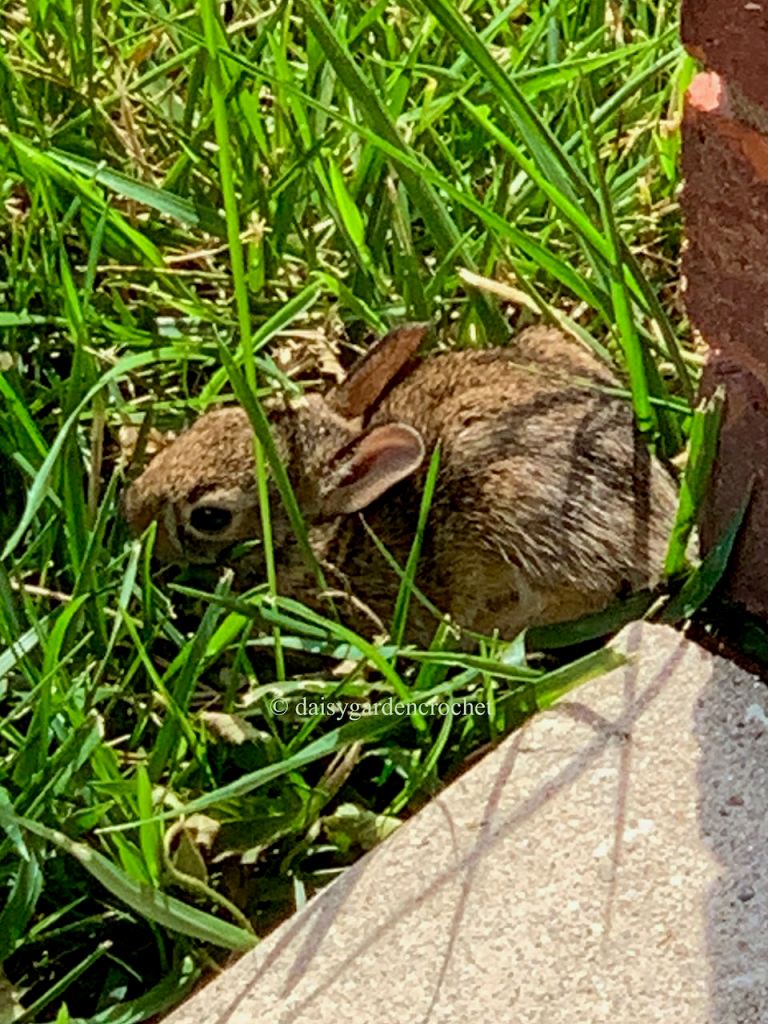
Since I don’t plan on having rabbit pie, but I do want to enjoy vegetables and flowers in the garden, I’ve used chicken wire crop cages to cover my raised beds this year. So far, they’re working. But short of blanketing my yard with chicken wire, I’ve needed other solutions to protect my annual and perennial flowers in the beds around the house.
To protect my wave petunias in the front yard, I am using a homemade cayenne pepper spray (see below for the recipe) that also seems to be working. I’ve had some nibbles, but so far there hasn’t been wholesale destruction like I had last year. The only downside is that I have to reapply the spray every time that I water, or it rains. I don’t mind the effort because I love seeing the carpet of petunias every time that I pull into the driveway, but I’ve come to the realization that an ounce of prevention is definitely worth a pound of cure.
In this case, prevention means planting things that the rabbits really don’t want to eat. It’s limiting and frustrating, but it works and is much less aggravating than working all day in the garden planting new plants only to discover the next morning that everything has already been eaten.
So, if you too are looking to get horrible Yelp reviews from the rabbits in your garden, here are some annuals and perennials that have been rabbit resistant in my garden. I’ll leave you with fair warning though; whatever the rabbits leave behind, the deer might find delicious.
Rabbit Resistant Annuals in my Zone 6b Garden
Impatiens
Sweet alyssum
Calibrachoa (Superbells®, Million Bells®)
Verbena*
Lysimachia nummularia ‘Aurea’ (golden creeping jenny)
Coleus
Mandevilla
*2023 is the first year that I have had an issue with rabbits eating my verbena. They are eating just the blossoms and leaving the plant intact. Sprays have not worked. Be warned!
Rabbit Resistant Perennials in my Zone 6b Garden
Millenium and Serendipity Allium
Rudbeckia (Black-eyed Susan)
Peony
Bearded and Siberian Iris
Lavandula x intermedia ‘Niko’ (Phenomenal™ lavender)
Hyacinth and Daffodil bulbs
Amsonia
Geranium ‘Rozanne’ (Cranesbill)
Anemone ‘Honorine Jobert’
Phlox subulata (creeping phlox, moss phlox)
Clematis
Perovskia (Russian sage)
Liriope (lilyturf)
Heuchera (coral bells)
Nepeta (catmint)
Hakonechloa macra ‘All Gold’ (Japanese forest grass)
Salvia ‘Azure Snow’ (garden sage)
Veronica ‘Wizard of Ahhs’
Cayenne Pepper Spray Recipe
Cayenne pepper is HOT. I recommend eye protection and gloves when making the recipe, and adding a mask when spraying it. Keep out of reach of children and do not apply with pets nearby.
Steep 1 and 1/4 teaspoons dried, ground cayenne pepper in 16 ounces of warm water for about 3 hours. After steeping, filter through a coffee filter. Transfer to a spray bottle and add another 16 ounces of water for a total volume of 32 ounces.
Since the spray has no preservatives, I label it well and store it in my refrigerator. Before I use the spray, I bring it to room temperature and mix it well. I have only used the spray on my petunias, so I would recommend testing it on a leaf or flower of any other plants first to make sure that the spray itself doesn’t damage the plant that you are working so hard to protect from rabbits.
 DaisyGardenCrochet